
Statement of Accounts in the United Kingdom
The statement of accounts, otherwise known as a customer statement, summarizes the transactions between the customer and seller for a certain period that is under analysis. It is basically a snapshot or summary of the transactions that are executed between the seller and the customer.
This statement of accounts is an excellent tool to monitor and keep track of the financial relationships between the parties. Generally, there are three components of the statement of accounts. These are, details of the invoice by the seller, payment by the customer, and the balance (receivable for the seller and payable for the buyer).
It is important to note that the statement of accounts is generated and sent by the seller to the customer.
Statement of Accounts Example
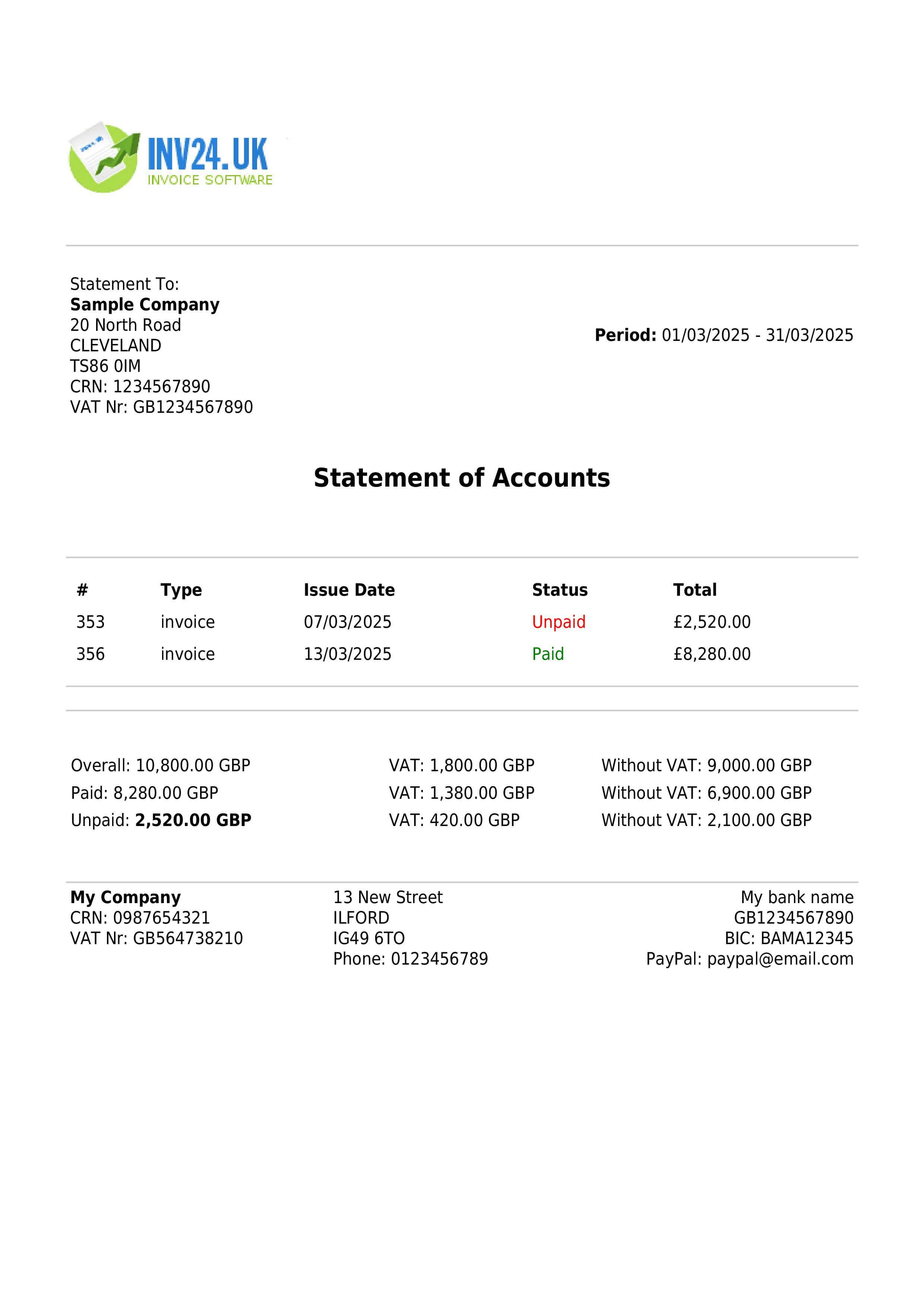
What Should a Statement of Accounts Show?
The statement of accounts contains the following components:
Information specific to the customer
This information includes the name of the customer, address, contact information, as well as other pertinent information. Generally, it is the same information that is mentioned on the invoice and it helps to locate and track the customer.
Information about economic activities (sales, payments, and adjustments)
Invoice listing
This refers to the list of the invoices generated by the seller. It contains content such as invoice number, invoice amount, invoice date, invoice due date and so on. It can be thought of as a cluster of all the invoices generated and sent by the seller for the period under consideration.
Payment listing
This is a list of the payments made by customers. It contains data such as payment amount, payment date, payment method as well as others. In other words, it is a cluster of all the payments sent by the customer.
Adjustment listing
This includes information relating to adjustments in the customer's ledger. For instance, there may be adjustments for credit notes or some special discounts.
Outstanding Balance information
The basic purpose of sending a statement of accounts is to communicate the outstanding balance with the customer. This helps the customer to reconcile their books with the books of the seller. Further, if there is a difference in the payable balance at the customer's end and the statement received, the details of the balance can be checked with a breakdown of the invoice and payment listing (statement of accounts). In the event that there is any discrepancy, this can easily be communicated to the seller and resolved.
Additionally, an account statement is also sent in order to remind the customer of the payment. In fact, it can be thought of as a smart move to use. An account statement can be sent to remind customers to make payments as details of the balance can be reconciled on a timely basis. Furthermore, corrective action can be agreed upon without any further delay.
Other essential information
Other essential information can be about terms and conditions such as payment terms, late fees, and other consequences of not paying the balance on a timely basis. The seller's contact information and statement date are also considered as essential information for the statement of accounts.
Next will be a discussion on the advantages of using a statement of accounts.
Advantages of the Statement of Accounts
There are numerous benefits of using a statement of accounts, which are as follows:
Account reconciliation
The statement received from the supplier contains the complete details for the invoices and payments. This therefore makes it easy for the customer to reconcile their payable balance with the seller's receivable balance.
Payment verification
The statement contains a list of all the payments that are received from the customer. This makes it easier for the customers to ensure that the seller has recorded all the payments that they have made. This is done by reviewing the statement of accounts. The statement acts as a verification or confirmation of the payments that the customer has made to the supplier.
Acts as payment reminder
Sending a statement can be considered as a payment reminder. By regularly sending reminders, it helps to remind customers about the payment which they need to make. In this way, it helps to enhance cash collection speed.
Documentation
The statement of accounts can help to recover the funds from the buyer in case there is some dispute. This is because statements of accounts can be used as evidence to demonstrate the accuracy of the receivable balance.
Enhanced financial record
The statement of accounts is considered as an essential component of the accounting record. This means that it can be used in times of financial audit, financial reporting, tax audit and any other compliance-related activities.
Enhanced communication and trust building
Sending statements enables the fostering of enhanced bonding between customers and sellers. This is due to the fact that regularly sending the statements to the customers, demonstrates a business commitment to the accuracy and transparency of the accounting record.
Dispute resolution
There may be some times when there is discrepancy in terms of invoices, payments, or other adjustments. This happens when the seller’s receivables and the buyer’s payables do not match. This is when a statement of accounts can come in handy. A line-by-line comparison of the statement with the customer's accounting record can help to spot where the problem is. For instance, if there is an additional invoice in the statement received from the supplier, the customer can request the seller to send all relevant details and so on. Hence, this statement acts as a tool to identify the problem and resolve the dispute.
Record transparency
The credibility of the accounting record is enhanced once it is reconciled. It therefore creates ease for both supplier and buyer in terms of record keeping as well as maintaining the accuracy of the financial reporting.
Budgets and forecasting for working capital management
For customers, the accuracy of the payable balance on the statement helps to create a cash forecast. By reviewing the payable balance on the statement, customers can better incorporate these payments into their budget.
Transactions accuracy
The balance (receivable and payable) reconciliation at both ends (seller and customer), helps to ensure that transactions are accurately recorded in both the supplier’s and the customer’s accounting ledgers. If there should be any mistake or discrepancy, it will be identified and corrected on a timely basis.
Helpful in financial reporting
Statements of accounts help to understand the extent of receivables and payables from specific customers and suppliers. It therefore allows the business to make strategic decisions about whether they should continue working with a counter-party, for example, in terms of credit approval as well as other issues.
In short, a statement of accounts encourages the customer to make timely payments, while also establishing the customer’s responsibility to make those payments. This in turn, helps to improve business cash flow collection. The statement of accounts also helps to identify if there is any misstatement in the record of the seller or buyer, serves as a record purpose, and also helps to enhance overall business credibility and reputation.
How to Create a Statement of Accounts?
Use our simple invoice software
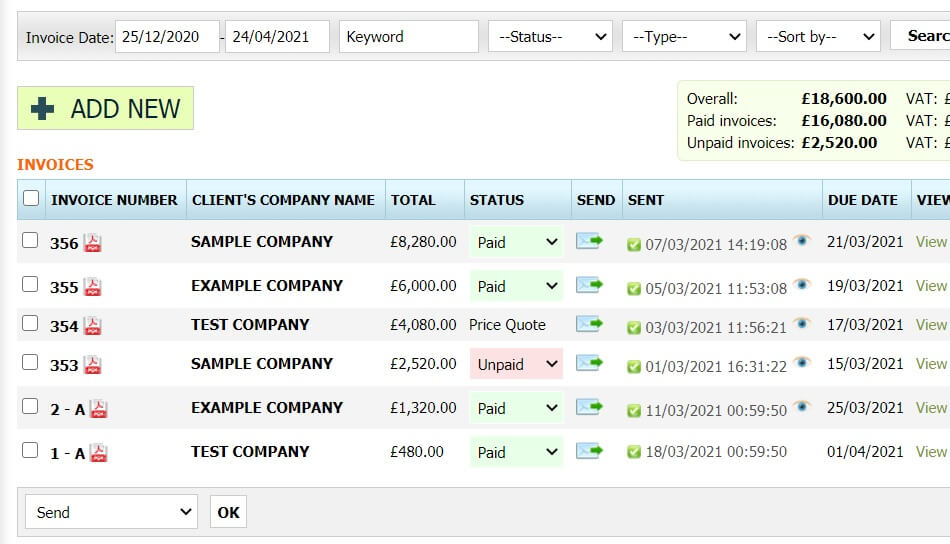
You can quickly make professional-looking statements of accounts in the following section: Clients → Statements.
Try It FreeDownload a free statement of accounts template
Free Statement of Accounts Templates for UK: PDF, Excel, Word, Google Sheets, Google Docs
How do you Deliver a Statement of Accounts?
There are many different ways in which statements of accounts can be delivered. Such modes of delivery include, delivery via mail, email, by customer portal, accounting software, secured document-sharing platform or any other way of communication.
In usual practice, a statement of accounts is usually sent to the customer in the same way as invoices. However, this is not a general rule, and it can take any form depending on the business preference, resources, and industrial practices.
Next will be a discussion on the different methods used to deliver a statement of accounts.
By mail (printed statement)
This is a traditional method of sending the statement and has been used for many years. The content of the statement is printed, enveloped, and dispatched to the client. It is a widely acceptable method, however, it is expensive and is not known to be highly efficient. As mentioned, it is expensive in terms of paper, printing, and postage expenses. Moreover, the use of paper is not considered feasible from the perspective of the environment.
By email (sending a file)
Sending electronic files such as in PDF, Excel or Word forms is considered an efficient and convenient mode of communication. It is paperless, secure, and widely used as a mode of communication. Additionally, in contrast to delivery by traditional mail, the cost associated with opting for this mode of communication is minimal. The only downside is that there is a need to take care of data security, email delivery issues and file size limitations. There is also a lack of personal interaction with the customer.
Customer portal
The customer portal is a dedicated area for specific customers. It is a way to communicate with the customers, in terms of providing documents such as invoices and statements. The portal enables customers to access a comprehensive database with real-time updates. This makes it a highly efficient, automated, and secure mode of delivery. It also comes with a higher span of controls. Despite this, there are shortcomings associated with using customer portals. These downsides include, reliance on the internet, a massive cost of system implementation, compatibility and complexity issues, as well as others.
Accounting software
Accounting software is considered a highly efficient and organized business tool to send financial documents, such as invoices and statements. The advantage of using accounting software, is the capability to automate the process in terms of timing, frequency, and other details. The only downside, is that there is a financial cost associated with a subscription to the accounting software.
Secured platform
In today’s business world, there is an increasing trend of the use of document-sharing platforms which include, EDI and PEPPOL. These examples of document-sharing platforms are considered fast, efficient, flexible, and highly secure. However, there are certain costs associated with the implementation and usage of these platforms.
When selecting the method of delivery to use to send statements of accounts, it is important to note that any of the above modes of delivery are acceptable. It is necessary to bear in mind the pros and cons of each method.
Next will be a discussion on how often a statement of accounts is sent to customers.
How Often Should a Statement of Accounts be Sent?
While there is no specific rule in regards to the frequency of sending out statements of accounts, it is advisable to send the statement on a regular basis. This could be weekly, monthly, quarterly and so forth.
Generally, the frequency of sending the statement is dependent on customer preference, billing frequency, industry practices, transaction volume, as well as other considerations.
Customer preference refers to their willingness as to how frequently they would like to receive the statement. Certain customers would like to receive the statement more frequently. This might be because they would prefer to be kept reminded about their dues and bills. On the other hand, some customers consider the statements as a waste of resources. This is why it is a good idea to obtain the customer’s feedback and deal with each customer, individually, in line with their preferences.
If a customer is billed more frequently, it is a good idea to send them more frequent statements and so on. For instance, if the customer is invoiced monthly, it is more logical to send them a monthly statement of accounts. This means that updated details of the statement can be reconciled at both ends.
In addition, the number of transactions that a business has with a seller can be a deciding factor when contemplating the frequency of the statement. If for example, there is a large volume of transactions, there may be a need for more frequent regular statements so that it is easier to reconcile the transactions and vice versa.
Likewise, industry practice refers to acceptable norms and culture of the industry. So, it is a good idea to research the statement frequency of the applicable industry and act accordingly.
Statement vs Invoice
It is important to note, that the statement of accounts should not be confused with an invoice. Both are financial documents, however, they serve different purposes. The following table summarizes the difference between the two.
| Invoice | Statement of Accounts |
| The main purpose of the invoice is to request payment for the goods delivered or services performed. | The main purpose of the statement of accounts is to provide a summarized breakdown of financial transactions to ensure both seller and buyer are on the same page regarding accounting records. |
| Invoices contain details of the transaction for which payment is being requested. For instance, item price, item description, item quantity delivered as well as others. | Statement of accounts contains a listing of the invoices and payments exchanged between parties. Additionally, it contains summarized information such as invoice numbers, invoice totals, invoice dates, payments, credit, current and previous balances. |
| Invoice is a primary document that serves a legal purpose. | Statement of accounts is a supportive document that serves to enhance the credibility, completeness, and accuracy of the financial record. |
| The invoice is generated once goods are delivered or services have been performed for the customers. | The statement is usually generated after a fixed span of time. For instance, weekly, monthly, or yearly. |
As noted, an invoice is simply request for payment. A single invoice is backed by purchase order and/or delivery note depending on the business operations and billing mechanism.
On the other hand, the statement lists several invoices that have been sent to the customer within specific time frame. Generally, the statement is sent to the buyer, to highlight unpaid invoices and balance (credit / debit) between the parties. This is done in order to collect the payments from them.
Conclusion
The statement of accounts is a financial document that summarizes all the transactions between the seller and customer. This summary includes a listing of the invoices and payments along with other relevant details including invoice numbers, invoice dates, payment amounts, payment dates, credit and debit on the balance, previous balance, and current balance.
One function that sending the statement of accounts has, is that it acts as a reminder for the customer to make payment. Additionally, it is a powerful tool that allows the reconciliation of receivable balances in the books of the sellers and the payable balances in the books of the customers. Should there be any difference in their accounting records, it can be sorted out on a timely basis.
As mentioned, there are various advantages of using the statement of accounts, which include, but are not limited to, records reconciliation, payment reminder, payment verification, documentation, enhanced financial record, transaction accuracy, accounting records transparency, and help in financial reporting.
There is no specific rule in regards to the frequency of sending the statement. However, the frequency does depend on the customer's preference, industry practices, volume of transactions, billing frequency and so on. Similarly, the business is able to select any method to send the statement to the customers. These modes of delivery include sending mail, email, via a customer portal, accounting software and secured platform, as well as others.
It is important to highlight that statements of accounts are different from invoices. An invoice is sent as a request to receive payment from the customer. On the other hand, the basic purpose of a statement is to reconcile the receivable balance in the books of the seller and the payable balance in the books of the buyer. Another contrast is that the invoice is generally issued after delivery of the goods and services whereas a statement is issued on some periodical frequency, such as weekly, monthly and so on.
CREATE STATEMENT OF ACCOUNTS ONLINE
Invoicing Tools for UK: